
Robotic Stud Welding Can Help Manufacturers Offset Skilled Welder Shortages
November 03, 2026
November 03, 2026
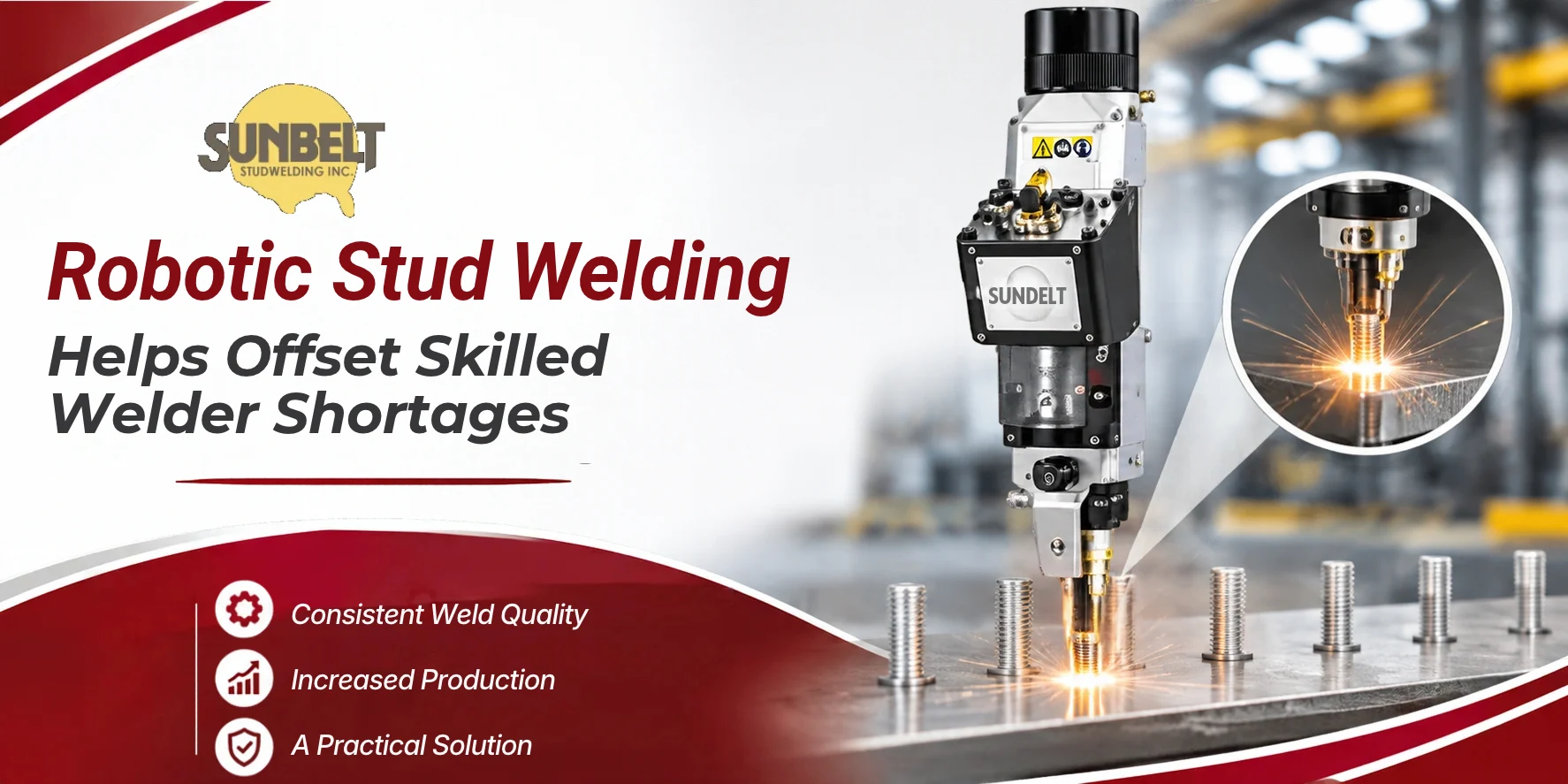
Skilled welder shortages continue to challenge manufacturers across the United States. Finding experienced workers can become difficult as production demands increase. At the same time, manufacturers must maintain weld quality, meet deadlines, and control labor costs.
Robotic stud welding offers a practical way to address these challenges. Automated systems handle repetitive stud placement and welding tasks. This allows skilled workers to focus on more complex jobs while manufacturers maintain steady production.
The numbers show a tight labor market. The American Welding Society estimates the U.S. had about 771,000 welding professionals in 2024. More than 159,000 of them are approaching retirement.
The U.S. Bureau of Labor Statistics (BLS) projects approximately 437,700 job openings for welders each year from 2025 to 2035. Many openings will come from retirements and workers leaving the occupation.
The problem reaches the whole factory floor. Deloitte and The Manufacturing Institute say U.S. manufacturing could need as many as 3.8 million new workers by 2033. They warn that 1.9 million of those jobs could go unfilled.
Skilled welder shortage statistics like these explain why shops want welder shortage solutions that work now.
Robotic stud welding mounts a stud welding gun on a robot arm. A feeder delivers each stud to the gun. The robot moves to every programmed spot and starts the weld.
A stud welding robot can use arc or capacitor discharge methods. Arc stud welding suits larger studs on heavy plate. Capacitor discharge suits small studs on thin sheet metal.
Sunbelt Stud Welding offers robotic stud welding systems and automated welders for production work.
A robot stud welding machine takes over the repetitive work that ties up your best people. Your crew can then focus on fit-up, inspection, and complex joints.
Here is what a robotic cell does for your shop.
One trained technician can then watch the cell and reload parts. That technician does not need years of manual welding practice.
Robots shine on high-volume parts with many studs. They also help when customers demand clean records and tight tolerances.
Robotic automation works best when the equipment matches the application. Manufacturers should review several factors before selecting a system.
A proper application review helps prevent equipment mismatches and unnecessary investment.
No. Robotic stud welding does not eliminate the need for skilled welding professionals. It changes how manufacturers assign welding tasks.
Robots handle repetitive and programmed operations. Skilled workers remain important for equipment setup, quality checks, maintenance, and complex welding work.
The best approach combines trained employees with suitable automation. This helps manufacturers maintain production without relying entirely on manual labor.
No single tool solves the whole problem. The best welder shortage solutions work together.
A stud welding robot is a robot arm carrying a stud welding gun and stud feeder. It moves to programmed points and welds each stud automatically. It gives repeatable placement and weld quality on production parts.
No. It shifts welders toward setup, programming, inspection, and quality work. The robot handles the repeat welds that are hard to staff.
Yes, when the same parts run often. Many shops start with one cell on their highest-volume part. They add more cells as the savings show up.
Skilled welder shortages can affect production schedules, labor costs, and manufacturing output. Robotic stud welding gives manufacturers another way to manage these challenges.
Sunbelt Stud Welding has supplied stud welding equipment since 1980. Our team can help you match robotic stud welding components and automation solutions to your studs, parts, and output goals.
Call toll-free at 1-800-462-9353 or reach the Houston office at 713-939-8903. You can also request a quote online.