
How Stud Welding Automation Improves Production Speed and Consistency
October 14, 2026
October 14, 2026
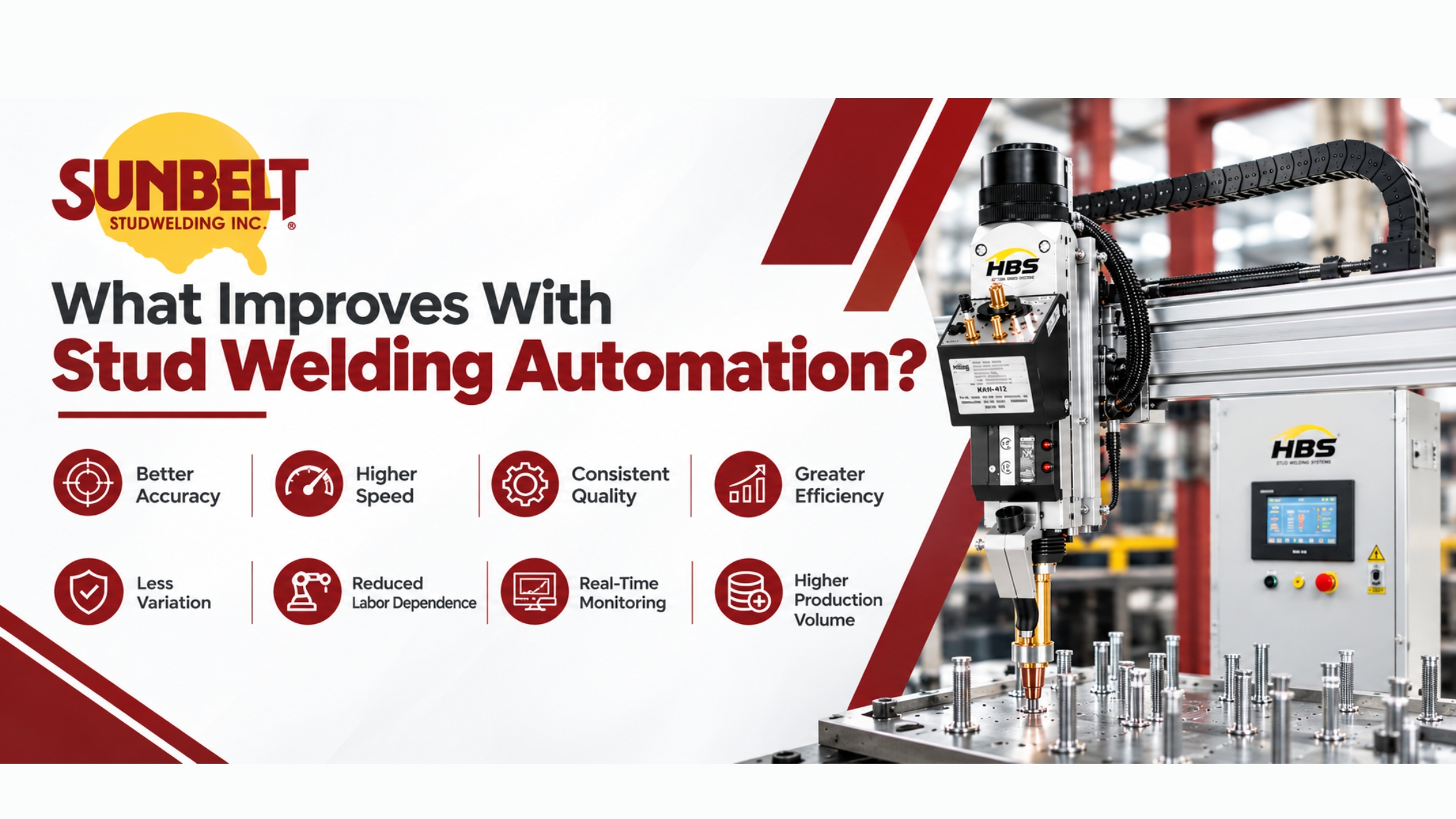
Stud welding automation improves production by controlling three critical variables at the same time: stud positioning, stud feeding, and the welding cycle. Instead of relying on an operator to manually locate every stud and repeat the welding sequence, CNC stud welding and automated systems execute programmed movements and weld parameters with consistent timing.
For manufacturers producing hundreds or thousands of identical parts, this changes the production process from operator-dependent welding to a repeatable, programmable operation.
In manual stud welding, the operator moves the welding gun from one location to another for every stud. That movement becomes a significant part of the production cycle when a component requires dozens of studs. A CNC stud welding machine uses programmed coordinates to position the welding head.
| CNC Function | Production Effect |
|---|---|
| X/Y positioning | Moves the welding head between programmed stud locations |
| Z-axis movement | Controls welding-head height and accommodates workpiece geometry |
| Servo-driven motion | Provides controlled, repeatable positioning |
| Stored part programs | Repeats the same stud pattern without manual measurement |
For example, the CPW Series CNC Production Welder has a programmable X/Y/Z system, automatic stud feeding, and positioning repeatability specified at ±0.05 mm. The welded-stud positioning accuracy is specified at ±0.2 mm.
This level of positional control supports automated, consistent stud placement when multiple studs must align with holes, brackets, insulation components, or mating parts.
Stud feeding is another production bottleneck. A manual operator must retrieve, load, position, and weld each stud. An automatic stud feeding system separates these tasks by supplying studs directly to the welding head.
A typical automated sequence is:
Bulk studs → feeder → feed tube → welding head → weld cycle → next position
Depending on the equipment configuration, feeding may incorporate a vibratory bowl, mechanical feeding mechanism, or other bulk stud feeder automation technology. The objective is the same: deliver automatically fed weld studs to the welding head without requiring the operator to manually load each stud.
The VBZ-3 automatic feeder, for example, is designed to feed flanged welding elements automatically. Its published specifications include stud diameters from 3 to 8 mm, lengths from 8 to 50 mm, and feeding speeds up to 30 studs per minute, depending on the welding element and feed configuration.
This does not mean every automated system welds 30 studs per minute. Actual production rate depends on the stud, welding process, positioning distance, part geometry, and machine configuration.
Automation does more than move the welding head. The welding controller can coordinate the parameters required for the selected stud welding process. Sunbelt automated systems support Capacitor Discharge (CD), Short Cycle, and Drawn Arc processes depending on the equipment configuration.
A programmed cycle can control factors such as:
The advantage is repeatability. Once the appropriate welding schedule has been established for a specific stud, material, and application, the same programmed sequence can be used across the production run.
The welding head is a critical part of the automation system because it controls the physical movement of the stud during the weld cycle. For automated applications, Sunbelt offers heads such as the KAH 412, which incorporates digital measurement of welding-piston position and allows direct adjustment of plunge and lift dimensions. The KAH 412 LA additionally provides mechanical length compensation for welding elements.
This matters because stud welding is not simply a matter of bringing two pieces of metal together and applying current. The welding head, stud, base material, and programmed weld cycle must work together correctly.
A common mistake is to measure automation only by weld time. The actual production cycle includes:
Load → Position → Feed → Weld → Retract → Reposition → Repeat
Automation can reduce production time by minimizing unnecessary operator movement, manual stud handling, positioning errors, and pauses between welds. For high-volume work, these small reductions accumulate quickly.
A CNC system can also store a programmed sequence, allowing the machine to move directly between known weld coordinates instead of requiring an operator to locate each position manually. Sunbelt's production systems range from single-head manual-load configurations to fully automated multi-head CNC systems.
When a component contains multiple stud patterns, a single welding head may require repeated positioning cycles. Multi-head automation can address this by using more than one welding head within the production system. The IPC 90 automated stud welder, for example, can control up to five welding heads and is designed for integration into production lines.
The engineering benefit is not simply "more welds." The system can be configured so that different welding operations are performed in a coordinated sequence, reducing unnecessary machine movement and improving utilization.
Automation does not always mean using a robot.
CNC Stud Welding
CNC automation is particularly suited to parts with:
Robotic Stud Welding
Robotic systems use a six-axis industrial robot for more complex positioning. They are better suited to curved, angled, or multi-plane components where fixed CNC movement may not provide sufficient flexibility. Sunbelt's robotic systems combine the robot with a stud welding power source, automatic feeder, welding head, PLC/controller, HMI, and safety system.
| Production Variable | Manual Welding | Automated System |
|---|---|---|
| Stud positioning | Operator controlled | Programmed coordinates |
| Stud supply | Manual | Automatic Stud Feeder |
| Weld parameters | Operator/system dependent | Stored weld schedule |
| Movement | Manual | CNC or robotic |
| Part-to-part repeatability | Operator dependent | Program controlled |
| Process monitoring | Limited | Parameter monitoring available |
| Production volume | Labor dependent | High-volume feeding and automated sequencing |
The result is greater control over the complete welding cycle, not simply a faster welding arc.
Stud welding automation becomes particularly valuable when the same component requires a large number of studs, stud locations must remain consistent from part to part, or production volume makes manual positioning inefficient.
The appropriate stud welding equipment configuration depends on stud diameter, welding process, material, part geometry, number of weld locations, required cycle time, and desired automation level. For manufacturers evaluating custom automation solutions, these factors should be established before selecting the feeder, welding head, power source, and positioning system.
Sunbelt Stud Welding Houston provides automated welding machines, CNC production welders, automatic feeding systems, welding heads, and robotic stud welding solutions for production applications. Backed by experienced automation specialists and technical expertise, the right combination of positioning, feeding, welding, and controls can turn a repetitive manual operation into a more controlled and consistent production process.
Improve your production output today. Explore industrial stud welding equipment and automation options at Sunbelt Stud Welding, or contact our equipment team at 713-939-8903 or 1-800-462-9353 (toll-free) to discuss your production requirements with our qualified experts.