
How Modern Inverter Arc Stud Welders Improve Welding Performance
September 23, 2026
September 23, 2026
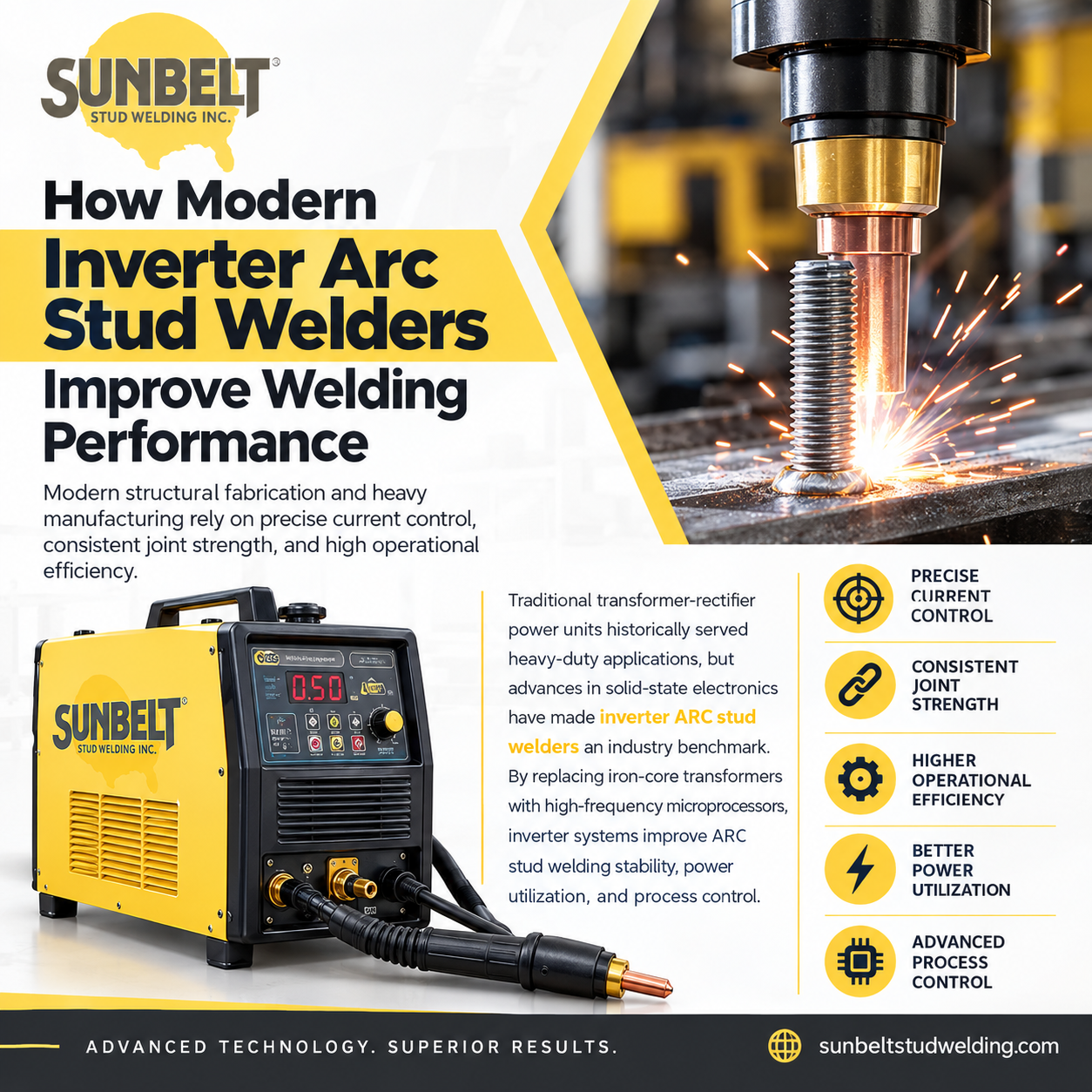
Modern structural fabrication and heavy manufacturing rely on precise current control, consistent joint strength, and high operational efficiency. Traditional transformer-rectifier power units historically served heavy-duty applications, but advances in solid-state electronics have made ARC stud welders an industry benchmark. By replacing iron-core transformers with high-frequency microprocessors, inverter systems improve ARC stud welding stability, power utilization, and process control.
An inverter ARC stud welder uses high-frequency electronic power conversion rather than the conventional transformer-based power architecture found in older welding systems. This allows the power source to regulate welding parameters rapidly and precisely throughout the welding cycle.
The result is a more responsive ARC stud welding machine with greater control over current, welding time, and process conditions. Modern inverter systems can also incorporate microprocessor- or microcontroller-based controls, digital displays, parameter libraries, and process monitoring.
Standard ARC stud welding equipment uses 50 Hz or 60 Hz line-frequency transformers to lower incoming AC utility voltage to welding levels. These analog systems feature large footprints, remain vulnerable to power fluctuations, and adjust output parameters slowly.
An inverter ARC stud welder processes electrical energy through three main stages:
Increasing the operational frequency from 60 Hz to tens of kilohertz allows modern stud welding equipment to reduce physical transformer size and total weight by up to 50% compared to equivalent conventional transformer systems.
During the ARC stud welding process, weld penetration and flash formation depend directly on current stability. Inverter power sources sample and correct output parameters continuously throughout the duty cycle.
If input line voltage fluctuates within standard field ranges, such as -10% to +10%, the ARC stud welding machine automatically compensates. High switching frequencies allow rapid response adjustments, preventing current drop-off and keeping output energy consistent.
Standard transformer welders draw significant idle power and operate with low primary power factors. Modern stud welding technology designed with inverter architectures achieves greater energy transfer efficiency.
Heavy-duty transformer systems often weigh hundreds of pounds, requiring specialized lifting gear for site movement. Modern inverter ARC stud welder designs achieve output currents up to 2,000 A from compact frames weighing around 320 lbs (145 kg) to 365 lbs (165 kg), depending on gun configurations. This reduced mass improves equipment positioning across structural bridge projects, shipyards, and industrial job sites.
Integrating digital microcontrollers into stud welding technology gives operators exact control over complex welding parameters:
Switching to modern inverter ARC stud welders provides precise current regulation, lower power consumption, and equipment mobility. Equipping your shop with advanced ARC stud welders ensures reliable fastener attachment across industrial applications.
Improve your stud welding performance today. Explore industrial ARC stud welding equipment , guns, and accessories at Sunbelt Stud Welding. Contact our equipment team at 713-939-8903 or 1-800-462-9353 (toll-free) for technical specifications or to request a quote.