Manufacturers turn to stud welding automation when production requires faster cycles, consistent stud placement, and repeatable weld quality. By combining CNC positioning, automatic stud feeding, programmable controls, and a suitable welding power source, automated systems reduce manual handling while delivering a controlled, repeatable process for high-volume production.
What Is Stud Welding Automation?
Stud welding automation uses automated positioning and feeding technology to place and weld studs at programmed locations with minimal manual intervention.
Instead of an operator manually positioning a welding gun for every stud, an automated system can coordinate:
- CNC or robotic movement
- Automatic stud feeding
- Welding head operation
- Welding parameters
- Part positioning
- Process monitoring and machine controls
The level of automation depends on the application. A CNC production welder may automatically position one or more welding heads, while a robotic cell can provide greater flexibility for complex or multi-plane components.
How Does Stud Welding Automation Work?
A standard automated stud welding system follows a controlled sequence from part loading through completed weld.
1. Position the workpiece
The component is secured using a fixture or worktable so the required stud locations remain accurately referenced.
2. Move to the programmed location
A CNC axis system or industrial robot positions the welding head according to programmed coordinates.
3. Feed the stud
An automatic feeder supplies the next stud through the feeding system and into the welding head.
4. Execute the weld
The welding power source applies the appropriate welding cycle for the selected process, such as Capacitor Discharge, Drawn Arc, or Short Cycle.
5. Repeat the sequence
The system moves to the next programmed position and repeats the cycle until the specified stud pattern is complete.
This controlled sequence is what separates production automation from simply using an automatic stud feeder.
Key Components of an Automated Stud Welding System
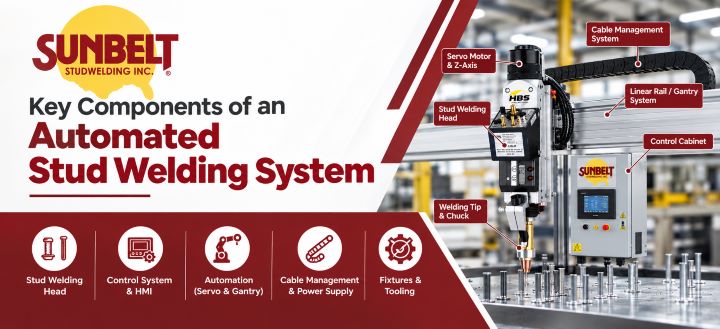
A complete stud welding automation setup can include several coordinated components.
CNC Positioning System
CNC positioning controls where the welding head travels across the workpiece. Sunbelt’s CPW CNC production welder, for example, uses programmable X, Y, and Z movement and specifies positioning repeatability of ±0.05 mm, depending on the configuration.
Welding Power Source
The power source supplies the electrical energy required for the selected stud welding process. Automated configurations are available for both ARC and Capacitor Discharge applications.
Automatic Stud Feeder
The feeder supplies studs to the welding head without requiring manual loading for every cycle. Sunbelt’s VBZ-3 feeder is designed for flanged welding elements from 3 to 8 mm and can feed up to 30 studs per minute, depending on the welding element and feeding tube.
Automatic Welding Head
The welding head controls the mechanical movement required during the welding cycle. Sunbelt’s KAH 412 and KAH 412 LA heads are designed for automated applications, with the KAH 412 LA providing mechanical length compensation.
Controls and Monitoring
PLC-based controls coordinate machine movement, feeding, welding sequences, and operator functions. Depending on the system, process monitoring can also help verify operating parameters during production.
CNC vs. Robotic Stud Welding Automation
Not every production application requires a robotic cell.
CNC stud welding is well suited to components with repeatable geometries and defined stud patterns. The welding head follows programmed coordinates, making CNC systems practical for standardized production work.
Robotic stud welding, by comparison, provides greater movement flexibility. A robotic cell can position the welding head around complex components and can be integrated with other manufacturing equipment.
Sunbelt’s robotic systems combine an industrial robot with a stud welding power source, automatic feeder, welding head, and programmable controls. They support CD, Drawn Arc, and Short Cycle applications.
| CNC Automation | Robotic Automation |
|---|---|
| Fixed programmed coordinates | Flexible multi-axis movement |
| Ideal for repeatable parts | Suitable for complex geometries |
| Efficient for dedicated production | Adaptable to changing applications |
| Compact production configuration | Greater integration flexibility |
Why Use Stud Welding Automation?
The primary value of stud welding automation is controlled repeatability.
For production environments, automation can help manufacturers achieve:
- Consistent stud placement
- Repeatable welding cycles
- Reduced manual handling
- Faster production throughput
- More consistent production quality
- Easier repeat production
- Integration with manufacturing lines
The benefit becomes particularly significant when the same component requires dozens or hundreds of studs to be welded repeatedly.
Where Is Automated Stud Welding Used?
Automated stud welding is particularly useful in production environments where stud locations and welding sequences are repetitive.
Common applications include:
- Automotive components
- HVAC panels and assemblies
- Electrical enclosures
- Sheet metal products
- Appliances
- Heavy equipment
- OEM components
- Industrial fabrication
Sunbelt’s production welding equipment includes CNC systems with automatic stud feeding and configurations supporting multiple welding heads for production applications.
When Should You Automate Stud Welding?
Automation makes the most sense when production volume, consistency, positioning requirements, or labor efficiency justify the investment.
Consider stud welding automation when:
- The same part is produced repeatedly
- Stud locations must remain highly consistent
- Manual positioning slows production
- Large numbers of studs are required per component
- Automatic feeding can reduce handling time
- The process needs to integrate with a production line
The correct system depends on the material, stud diameter and length, welding process, part geometry, number of weld locations, production rate, and required positioning accuracy.
Choosing the Right Stud Welding Automation System
The right stud welding automation system depends on your production volume, stud specifications, part geometry, welding process, and required positioning accuracy. Sunbelt Stud Welding provides CNC, robotic, automatic feeding, and production welding solutions tailored to different manufacturing requirements.
Need help selecting the right stud welding automation system? Call Sunbelt Stud Welding at 713-939-8903 to discuss your application.