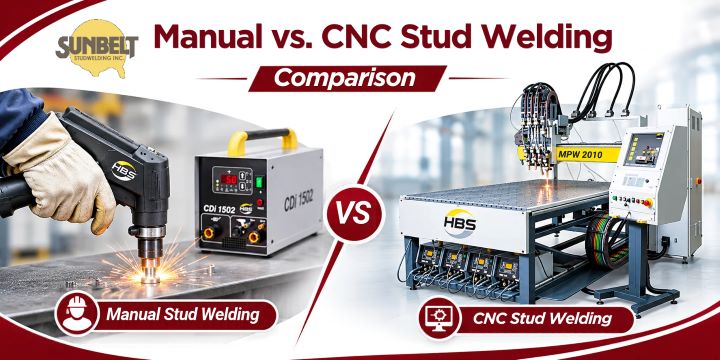
Choosing between a CNC stud welding machine and manual stud welding affects production speed, weld quality, and operating costs. Both methods join metal studs to workpieces, but they serve different production needs.
Manual welding gives operators direct control over each weld. CNC stud welding uses programmed movements and controlled welding cycles. Understanding these differences helps manufacturers choose the right equipment for their production goals.
What Does Stud Welding Do?
Stud welding joins a metal fastener to a base metal in a single quick step. The operator only needs access to one side of the part. Shops use the stud welding process for shear connectors, threaded studs, and pins.
Two main methods cover most jobs.
- Arc stud welding process.
An electric arc melts the stud tip and the base. It handles larger studs, up to about 1-1/4 inch in diameter.
- Capacitor discharge stud welding process.
Stored energy releases in a few milliseconds. It works well on thin sheet metal and small studs with little heat marking.
How Does Manual Stud Welding Work?
An operator holds a stud gun, places each stud, and pulls the trigger. A portable stud welding machine powers the gun. You can carry it right to the job site.
Manual welding gives you real advantages.
- Lower upfront cost for the equipment
- Easy moves between sites and tight spaces
- Good fit for repairs, one-off parts, and small batches
- Stud welding machine rental for short projects
It also has limits. Results depend on the operator’s skill and steady hands. Stud spacing and angle can drift over a long shift. Large layouts take more time.
What Does a CNC Stud Welding Machine Do Differently?
A CNC stud welding machine moves the weld head along programmed coordinates. It places every stud in the exact spot you set. Stud welding automation also repeats the same current, time, and plunge on each weld.
An automatic stud welding machine often adds a stud feeder. The operator loads the part and starts the cycle. This setup suits repeat parts like tank walls, heat exchanger plates, and switchgear panels.
Manual vs. CNC Stud Welding: Comparison
| Comparison | CNC Stud Welding | Manual Stud Welding |
| Stud positioning | Programmed coordinates | Operator positioning |
| Weld control | Stored weld settings | Operator-selected settings |
| Stud feeding | Can use automatic feeders | Usually manual feeding |
| Production speed | Suits repeated production | Depends on operator speed |
| Weld consistency | Repeatable programmed cycles | Depends on operator technique |
| Labor needs | Less hands-on welding | More direct operator involvement |
| Part flexibility | Best for planned layouts | Better for varied, one-off jobs |
| Initial investment | Higher | Generally lower |
Why Does Automation Matter Right Now?
The welding workforce is getting older. The American Welding Society estimates the U.S. had about 771,000 welding professionals in 2024. More than 159,000 of them are nearing retirement.
The U.S. Bureau of Labor Statistics also projects about 45,600 openings each year for welders through 2034. Skilled hands will stay hard to find. An automatic stud welding machine helps one operator cover more work with steady quality.
When Is CNC Stud Welding Required?
A CNC stud welder makes sense when manufacturers repeat the same welding pattern across many parts. It reduces the need to position every stud by hand.
Here are four situations where automation offers clear advantages.
1. High-Volume Production
Manufacturers that weld hundreds of studs across repeated parts can benefit from automation. A CNC system follows programmed coordinates and reduces manual positioning.
An automatic stud welding machine can also feed studs directly into the welding head. This reduces handling between weld cycles.
2. Accurate Stud Placement
Some assemblies require studs at precise locations. Even small placement errors can affect later assembly steps.
A CNC system follows stored coordinates for each weld location. Proper fixtures, calibration, and part alignment help maintain placement accuracy.
3. Repeatable Weld Settings
A CNC system can store welding schedules for different jobs. These settings may include current, weld time, and lift or plunge values.
This helps operators repeat approved settings across production runs. However, programming alone cannot guarantee sound welds. Material preparation, grounding, tooling, and inspection remain essential.
4. Reduced Repetitive Work
Manual welding requires operators to position and trigger the gun repeatedly. Automation handles much of this routine movement.
The National Institute of Standards and Technology (NIST) identifies productivity, consistency, and worker safety among the benefits of manufacturing automation.
Which One Should You Choose?
Manual welding fits you if your jobs change every week. It also fits if you work in the field or weld only a few hundred studs at a time. Renting a stud welder machine can cover a short contract without a large purchase.
A CNC stud welder fits you if you run the same part again and again. It also fits if buyers demand tight spacing and clean records. Many shops find the machine pays for itself through less rework.
Frequently Asked Questions
What is a CNC stud welding machine?
It is a stud welder mounted on a programmable motion system. The machine moves to set points and welds each stud automatically. This gives repeatable placement and weld quality on production parts.
Is manual stud welding still worth it?
Yes. Manual welding costs less and moves easily. It works best for repairs, field jobs, and low volumes.
Can I rent a stud welding machine?
Yes. Stud welding machine rental lets you test a process before buying. It also covers short projects without tying up cash.
Choose the Right Stud Welding Equipment for Your Production
The best choice depends on how often you weld, what materials you use, and how consistent your production needs to be.
Sunbelt Stud Welding can help you match equipment to your parts, studs, and budget. We provide portable stud welders, production systems, automatic feeders, and CNC stud welding solutions.
Call toll-free at 1-800-462-9353 or reach the office at 713-939-8903. You can also visit sunbeltstudwelding.com to explore equipment options.